The Plan Is Free Now.
The Promise Is Not.
Artificial intelligence is absorbing the planning of luxury travel. The industry is discovering that planning was never the scarce good.
The travel industry has spent two years arguing about whether artificial intelligence will replace travel advisors. That was always the wrong question.
Travelers are not asking machines to take responsibility for their trips. They are asking machines to do the work that was tedious, and they are keeping the parts that carry risk in human hands. Advisory work does not disappear. It relocates.
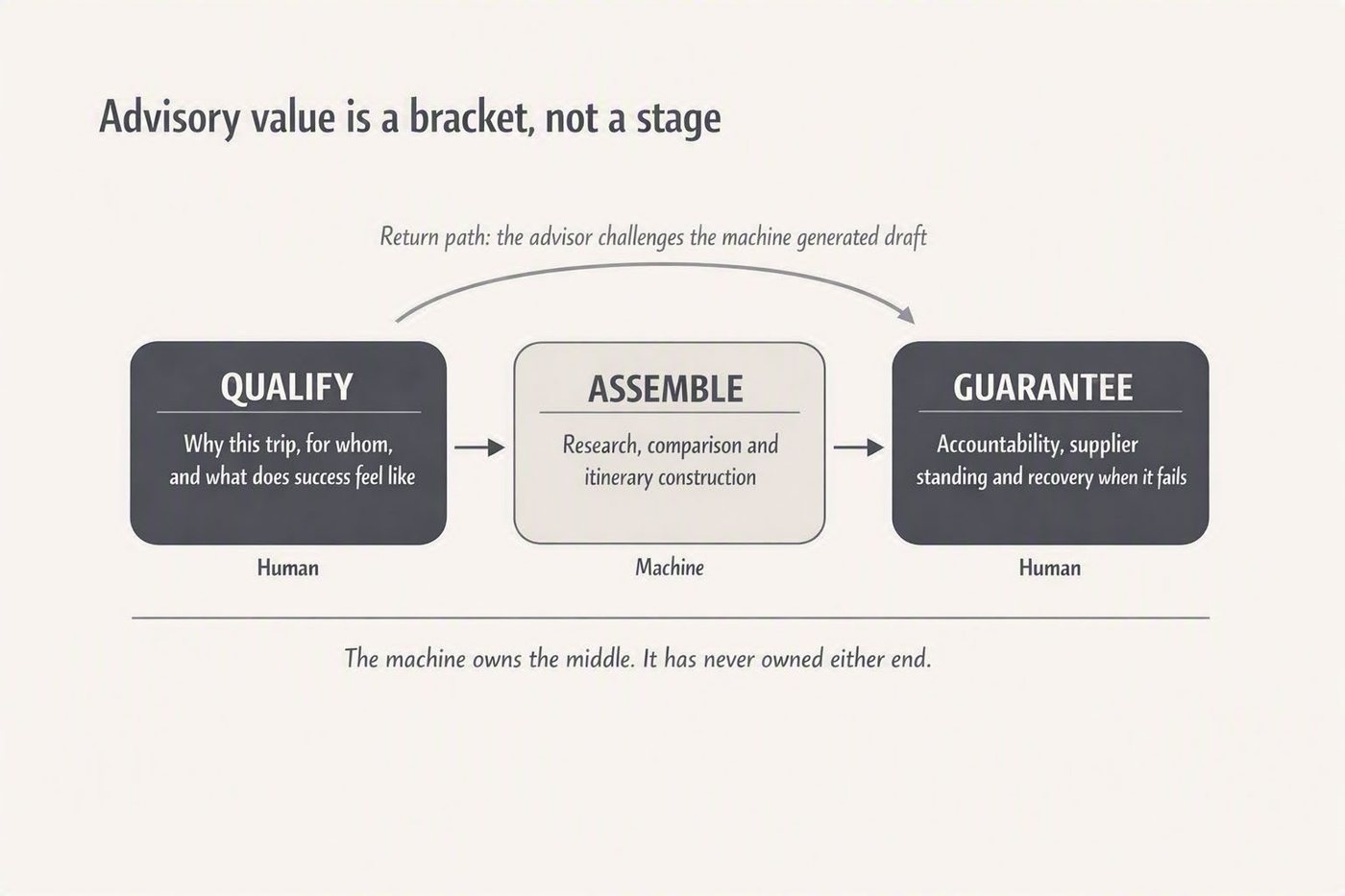
Two forces are converging and should be read together. Travelers now arrive with plans a machine built for them, which moves the advisor’s first task from creation to interrogation. Decisions are landing closer to departure, which moves the last task from arrangement to guarantee. Advisory value is not one stage of this process. It is the bracket around it.
Travelers have moved faster than the industry. Fifty four percent have already used artificial intelligence to plan travel and seventy five percent intend to use it again, while only two percent of travel companies have scaled agentic AI.
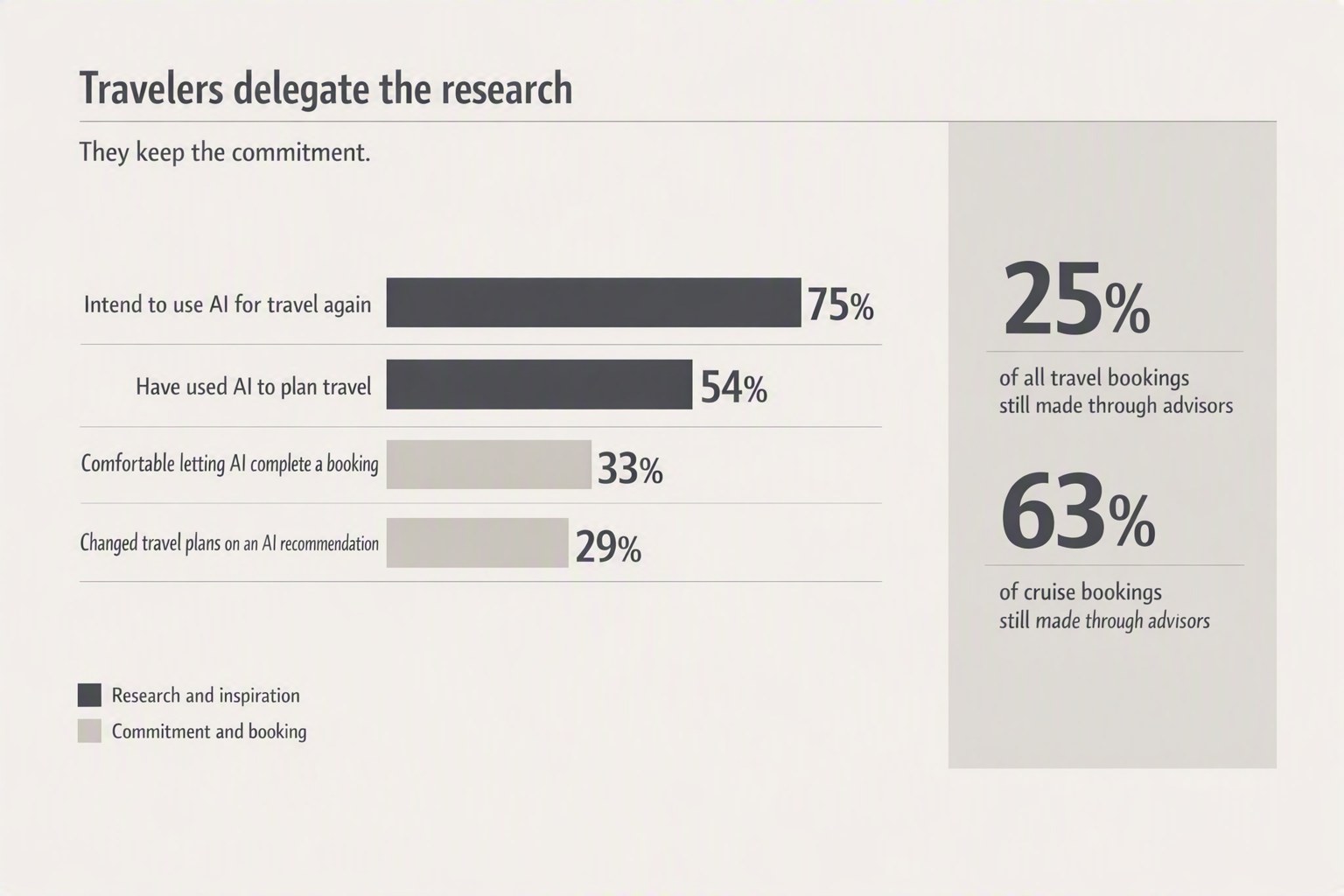
Delegation stops at the moment of commitment. Roughly a third of travelers are comfortable letting a machine book, and advisors still account for a quarter of all bookings and sixty three percent of cruise bookings.
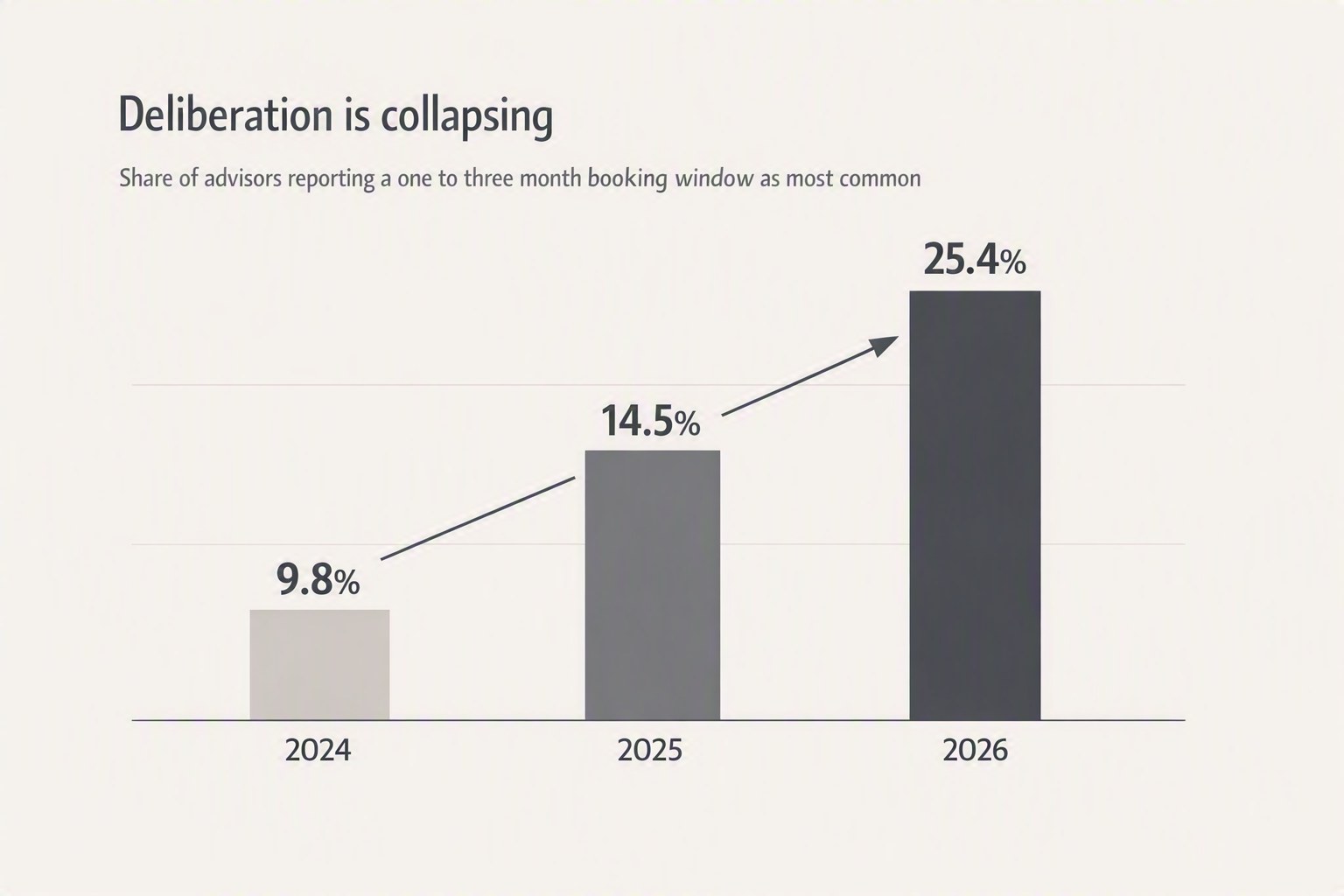
Deliberation time is collapsing. Advisors reporting a one to three month booking window as most common rose from 9.8 percent in 2024 to 25.4 percent in 2026.
The implication. Value is migrating away from itinerary assembly and toward qualification at the front of the journey and accountability at the back.
Market context
Research released on August 19, 2026 by Mindtrip with Sabre, Sojern and MMGY Travel Intelligence, based on a survey of 1,006 American travelers fielded in April, found that 54 percent have already used artificial intelligence to plan travel and 75 percent intend to use it again. Twenty nine percent have changed travel plans based on an AI recommendation.
Skift Research’s State of Travel 2026, reported on August 13, 2026, found familiarity with AI trip planning tools at 62 percent with usage up 124 percent year over year, driven disproportionately by high income and business travelers. Only about a third of travel companies are experimenting with agentic AI and just 2 percent have scaled it.
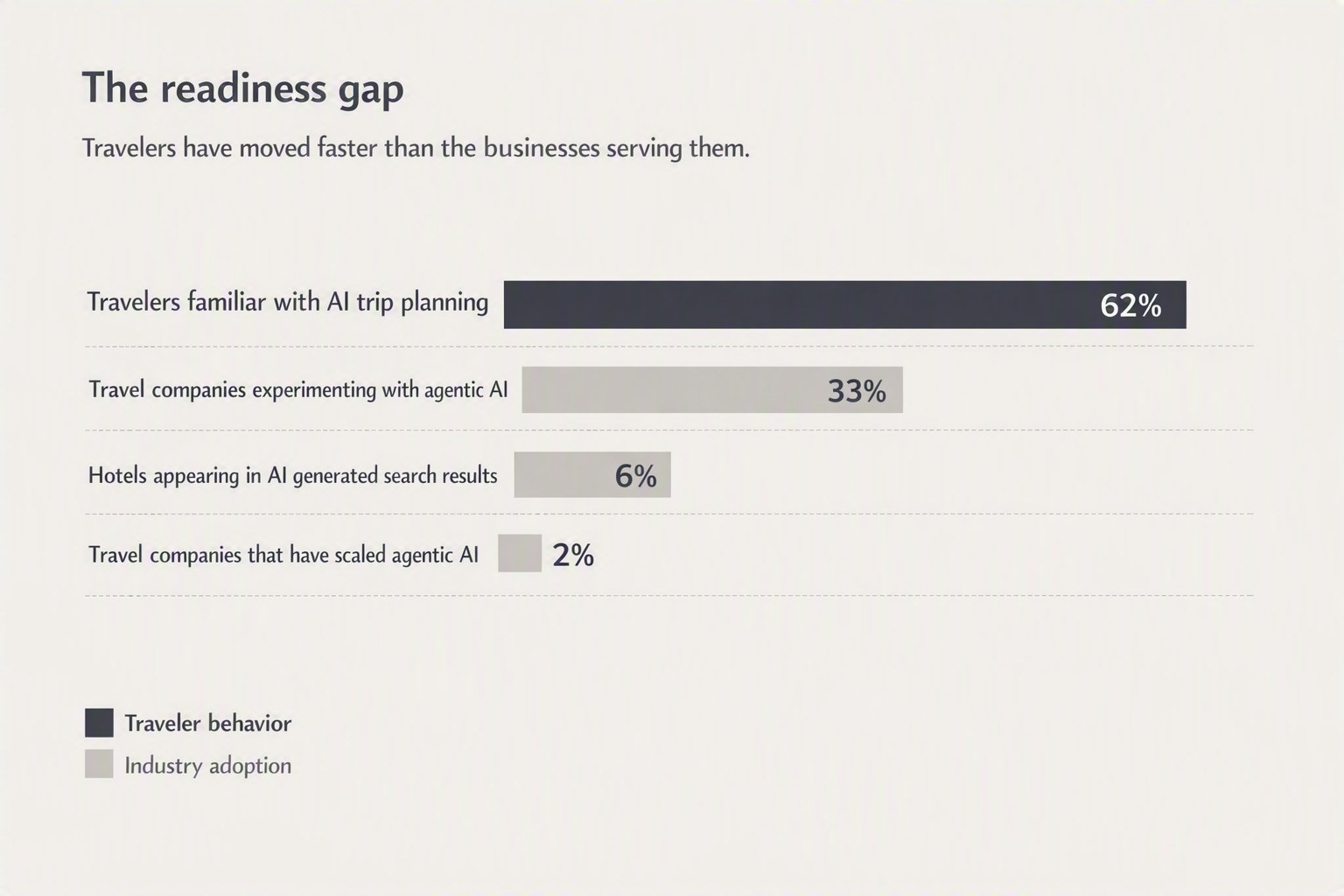
Two findings deserve more attention than they have received. The first is that comfort with allowing artificial intelligence into the booking process sits at roughly one third of travelers, and it rises significantly when travelers know human support is available if something goes wrong.
The second is that advisors remain responsible for roughly a quarter of all travel bookings and 63 percent of cruise bookings, in a market where planning assistance is abundant and free. The willingness to delegate collapses precisely where accountability begins.
Supporting evidence
Now add a third dataset rarely discussed alongside the first two. Travel Weekly’s March 2026 survey of 239 advisors found the share reporting one to three months as their most common booking window rose from 14.5 percent in 2025 to 25.4 percent in 2026, after sitting below 10 percent in 2024.
From the Virtuoso 2026 Luxe Report, released in November 2025, 67 percent of advisors forecast an increase in travel this year and 55 percent expect clients to spend more per trip.
Put those together and a picture emerges that is not about technology at all. Spending intent is intact. Deliberation time is collapsing. Decisions are landing closer to departure, at higher price points, in a market where operations have become less forgiving. That is a risk transfer, and someone absorbs it.
Analysis and critique
The industry’s dominant response to artificial intelligence has been a visibility response. Make our content legible to models. Put a planning assistant on the website. Show up in the answer.
That work matters. A property invisible at the first query has a commercial problem. But visibility is a race with a predictable ending. Every competitor is running it, and the advantage compresses to zero at the speed the software improves.
The critique I would offer, respectfully, is one of sequencing. We are pouring capital into the stage of the journey that is being commoditized, and comparatively little into the stage that is becoming scarcer.
Consider what a compressed booking window does. It removes the buffer and eliminates the second and third options. It puts travelers into properties selected under time pressure, often on the recommendation of a system with no exposure to the outcome and no standing with the supplier. When something fails, the traveler discovers what they actually purchased.
There is a second critique worth naming. Much of what the profession has called advisory work is itinerary assembly performed by a person. Software now does that competently, instantly and at no cost. Any business whose value proposition is speed of assembly is competing with a technology that will always be faster and cheaper.
The brief is the bottleneck
There is a third critique, and it comes from practice rather than from any dataset. Clients now arrive with itineraries they have generated themselves. It is a weekly occurrence and the number is rising. What is striking is not that these itineraries are badly built. Often they are competent and superficially impressive. What is striking is how frequently they are wrong for the person holding them.
The failure is not in the model’s reasoning. It is in the brief. A traveler types that they want to go to Italy and have a wonderful trip. The system does exactly what it was asked and returns a wonderful trip to Italy. What it never does is stop and ask why Italy. It does not ask what this trip is for, who in the family is difficult to please, or what this person is hoping to feel on the first evening. It cannot ask, because it does not know those are the questions.
A skilled advisor spends the first conversation almost entirely on the why. The where and the what follow from it, and they follow quickly. Reverse that order and you get a plan that is impressive and wrong, which is a more expensive failure than one that is obviously wrong, because nobody catches it until the client is standing in it.
This will improve. Consumers are becoming more sophisticated at prompting and models better at eliciting. But the narrowing has a floor, because a traveler cannot prompt a machine with self knowledge they have not yet articulated. Much of what an advisor draws out in a good discovery conversation is not information the client was withholding. It is information the client did not possess until a skilled person asked well.
So the honest picture is not a handoff from human to machine. It is a bracket. Qualification at the front, assembly in the middle, guarantee at the back, with a return path in between where the advisor challenges the draft and sends it back. The machine owns the middle. It has never owned either end.
Implications for luxury travelers
The traveler implication is the least discussed and the most important. What an affluent traveler buys from a serious professional was never the plan. It was time, certainty, access and advocacy. Above all it was recourse.
A capable model can produce a superb itinerary for Japan in ninety seconds. It cannot call a general manager it has a decade of history with. It cannot be accountable for a decision it recommended. It cannot rebuild a trip that has come apart with suppliers who will move because of who is asking.
Travelers who understand this distinction will use artificial intelligence enthusiastically for research and keep a professional for consequence. Travelers who do not will learn the difference expensively, once.
Implications for travel advisors
For advisors, the standard rises rather than falls, and the work changes shape. A growing share of engagements no longer begin with a blank page. They begin with a document the client has generated and is already attached to.
We see this weekly at Avenue Two, and the instinct to treat it as an intrusion is the wrong one. When a client arrives with a plan already in hand, whether it came from a machine or from a friend who went last spring, it is rarely a challenge to the advisor’s expertise. It is a clue. That client is telling us that the research is part of the pleasure for them, that the anticipation and the discovery are already part of the trip, and that they have no intention of being removed from it.
This explains a hesitation the profession has never fully answered. Many travelers are not skeptical of advisors because they doubt our expertise. They are skeptical because they fear our expertise will take the trip away from them, that the planning will disappear behind a curtain and reappear as a finished document they had no hand in shaping. Nobody wants the journey handed to them on a silver platter if the journey was half the fun.
A true advisor collaborates at every step, which means discovery has to include one more question that most of us have never asked out loud. How involved do you want to be in building this? Some clients want to hand us the destination and see it again only when it is finished. Others want to read every hotel description and argue about the third night. Both answers are correct. The failure is assuming one of them.
I will say plainly what I hear inside our own network and across the industry. When a client arrives with an itinerary that a machine produced, the advisor’s first reaction is often a quiet eye roll, and sometimes something less quiet than that. The reflex is understandable. It is also the single most expensive mistake available in that moment. The client hears contempt for work they were proud of, and the advisor who wanted to be seen as the expert has just confirmed the exact fear that kept that client away from advisors in the first place.
The better response is to set expectations and put guardrails around the work, early and explicitly. That is a conversation, not a correction. It covers what an advisor actually does, where the client’s own research fits within it, and how the two get combined. It says out loud that nothing is being taken away from them. Their ideas stay on the table and their enthusiasm stays in the process. What changes is that a professional is now underwriting the result.
Then comes validation, and this is where the professional actually earns the engagement. Checking a plan against where and what is straightforward work. The harder validation is why. Why this trip, why now, and what does this traveler want to feel on the first evening, when the door opens and the trip becomes real. A capable model can assemble a defensible list of places and activities. It has no access to why, because why was never in the prompt and frequently is not yet in the client’s own words. Drawing that out, and then holding the plan up against it, is the validation only a professional can supply. It is the difference between an itinerary that is technically correct and a trip that lands.
That makes the first conversation more important, not less. Qualification matters more because compressed timelines punish a poorly understood brief. Judgment matters more because clients arrive with a machine generated plan and need someone who can say which parts of it are wrong. Supplier standing matters because it is the only thing that produces a different outcome under pressure. Crisis performance matters most, because it is the moment the relationship is priced.
This creates a genuinely new task, and the profession should name it plainly. Reworking a machine generated proposal is harder than starting from a blank page. The advisor is not only designing a trip. The advisor is examining a plan the client believes is finished, keeping what genuinely serves the why, rebuilding what does not, and explaining the difference in a way that leaves the client feeling like a collaborator rather than someone who has been graded. Very few advisors have been trained for that conversation, and it belongs in how the industry develops talent from here.
None of that scales through effort. It scales through method, preparation and community. An advisor working alone can be excellent and still be fragile, because one practitioner cannot hold enough relationships to guarantee outcomes across a full book of business.
Implications for suppliers
For hotels, cruise lines, tour operators and destination management companies, the strategic question is what kind of demand you want.
Machine distribution is efficient and indifferent. It has no memory, no loyalty and no reason to advocate for you next season. Advisor distribution is slower to build and considerably more durable, because it carries preference and repeat intent.
That said, advisor distribution is not uniform, and it would be dishonest of me to pretend otherwise. The barrier to entry in this profession has always been low, and the tools now available have lowered it further. Anyone can produce a polished looking itinerary in a few minutes. Producing it is not the same as being able to stand behind it, and the gap between those two things is invisible on a booking request.
This matters to suppliers more than it may first appear, because you inherit the consequences. When a plan is assembled without the experience to pressure test it, expectations get set that no property can meet. The client was promised something the operation was never going to deliver, and the failure does not surface at the point of sale. It surfaces at your front desk, at your gangway, on your first night. The advisor who created the expectation is rarely the one absorbing the guest recovery. A skilled advisor is pairing the right client with the right hotel, the right ship, the right guide. That is a partnership where everyone wins.
So how to handle this dilemma? The answer is not to narrow the channel, and I would resist any suggestion that it should be. It is to be deliberate about it. The distinguishing quality is method rather than tenure. Some advisors two years into this business qualify with more rigor than practitioners of twenty years, and some do not. Look for the ones who ask the harder questions before they design anything, who bracket the trip rather than hand over a plan, who tell a client no when the plan is wrong, and who show up when something breaks. Those relationships are worth the investment they require, and they are the ones that protect your property when the week goes badly.
- What is your acceptance process, and what disqualifies a candidate?
- What training is required before an advisor is permitted to sell?
- Who supervises a new advisor’s first client engagements, and for how long?
- What happens operationally, and who picks up the phone, when a trip fails on a Saturday?
- How many of the advisors carrying your name into the market has your leadership team actually met?
None of these questions are hostile. All of them are answerable. The ease of the answer tells you most of what you need to know.
The properties that will do best pursue algorithmic visibility without allowing it to erode relational depth. That means continuing to invest in the preparation, education and mutual accountability that make an agency relationship productive rather than transactional. It also means recognizing which channel shows up when your operation has a bad week.
The Avenue Two perspective
I should be direct about my own position before making this argument. Avenue Two is a host agency. Scratch that, more appropriately we are a collective of travel professionals. We are in the same structural category as the businesses whose standards I have just questioned, and I am not going to pretend that the model itself is the differentiator. It is not. What differs is who is accepted, what is required of them once they are, and what they can reach for when a client is in trouble.
What that has meant in practice is a set of choices that are unglamorous and expensive. The first is the willingness to decline candidates who would produce revenue, screening for values and temperament before compensation ever enters the conversation. Some of the strongest advisors we have brought in were not working in travel at all, because the qualities that matter most, curiosity, discipline and the instinct to ask a harder question, are not industry specific. The second is writing the method down. How a trip gets qualified, designed and delivered exists for us as a documented framework rather than as instinct carried in the heads of our most senior people, which is the only way a standard survives growth.
The rest is standing and community. Our preferred partner relationships are built on selection rather than payment, with commitments running in both directions and standing reviewed rather than assumed permanent. And we organize as a collective rather than a roster, because the fragility of the solo practitioner is solved by other advisors more often than it is solved by the company. Neither of those is a marketing asset. They are infrastructure, and they take years to build.
What we have observed across that community is that the advisors whose businesses compound are almost never the fastest. They qualify rigorously before designing anything, they have earned genuine standing with their suppliers, and they work from a consistent method rather than personal improvisation. When something goes wrong at two in the morning, that combination changes the outcome. Speed does not.
None of this is offered as a claim of superiority. It is offered as a description of what it costs to produce the kind of advisor this article argues the market will increasingly require, and as an invitation to hold us to it. Technology accelerates that work. It does not originate it. The profession will not be saved by better software or lost to it. It will be decided by how seriously we take the business of developing the people who carry the promise.
Three practical leadership takeaways
- Audit where your value actually sits. Mark honestly which steps of your client experience a capable model now performs for free, then look at what sits on either side of them. If you have no rigorous qualification at the front and no rehearsed accountability at the back, you are competing with software where software wins.
- Invest in the recovery layer, not just the discovery layer. Most organizations can describe their marketing funnel in detail and cannot describe, with equal precision, what happens when a trip fails on a Saturday. Build and rehearse that capability. It is becoming the product.
- Treat supplier relationships as capital, not as a channel. Depth of relationship is the one asset machine distribution cannot replicate and competitors cannot buy quickly. Measure it, invest in it, and protect it against the temptation to chase whatever is easiest to book this quarter.
A closing question
Every forecast in this piece could be wrong about timing and the conclusion would still hold, because it does not rest on what the technology will do next. It rests on what travelers have already decided to keep in human hands. They have handed over the research willingly and enthusiastically. They have not handed over the consequence, and there is no evidence that they intend to.
So, the plan is free now, and that is not reversible. The promise is neither. It is made by a person, it is priced entirely by what happens when it is tested, and it is the only thing in this business that cannot be generated on demand. Every strategic decision in front of us should be measured against whether it strengthens that promise or quietly spends it.
I will put the question to the operators reading this. In your business, who owns the outcome when a trip fails, what have you actually done to prepare that person, and would your best client be able to name them? If the answer to the third is no, the first two matter far less than you think, because a promise nobody can locate is not a promise. It is marketing.
We have spent two years asking whether the machines are coming for us. It is the more comfortable question. The harder one, and the only one that will decide the next decade of this profession, is whether we have built something worth keeping.
Every figure in this piece traced to the study that produced it, with sample size and field date.
| Source | Published | Method | Figures used |
|---|---|---|---|
| Mindtrip with Sabre, Sojern and MMGY Travel Intelligence | August 19, 2026 | 1,006 United States adult travelers and 103 destination organization leaders, fielded April 2026 | 54 percent have used AI to plan travel; 75 percent intend to use it again; 40 percent discovered a destination through it; 29 percent changed plans on an AI recommendation; more than one third comfortable with AI in the booking step, rising when human support is available |
| Skift Research, State of Travel 2026, via trade coverage | August 13, 2026 | Fifth annual industry research report, 162 pages | Familiarity with AI trip planning at 62 percent, usage up 124 percent year over year; 33 percent of travel companies experimenting with agentic AI and 2 percent scaled; 6 percent of hotels appear in AI generated search results; advisors account for 25 percent of all bookings and 63 percent of cruise bookings |
| Travel Weekly reader survey | April 6, 2026 | 239 travel advisors, fielded March 2026 | Most common booking window of one to three months rose from 9.8 percent in 2024 to 14.5 percent in 2025 and 25.4 percent in 2026 |
| Virtuoso 2026 Luxe Report | November 19, 2025 | Annual survey of Virtuoso advisors across more than 50 countries | 67 percent of advisors forecast an increase in travel in 2026; 55 percent expect clients to spend more per trip |
© 2026 Joshua Bush. You are welcome to quote, excerpt and share this piece with attribution and a link. Figures are drawn from the sources listed above and should be cited to those sources rather than to this article.
Read it as a designed document
The full essay with charts, formatted for print and for circulating internally. Share it freely with attribution.
PDF, 13 pages, 440 KB
Josh speaks on this subject
Available as a keynote, a panel contribution or a fireside conversation, adapted to whether the room is advisors, suppliers or commercial leadership.